BNN Summary
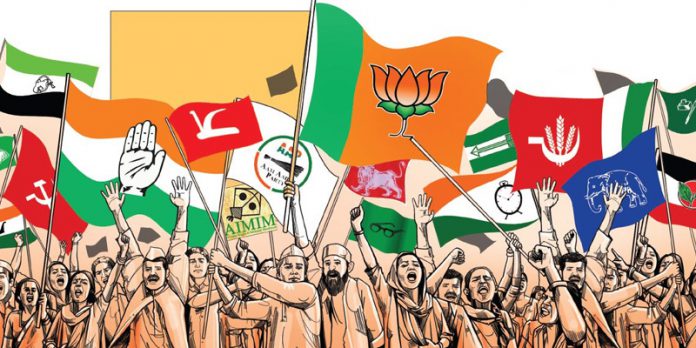
India's political landscape is undergoing a significant transformation as the Bharatiya Janata Party's (BJP) expanding dominance increasingly challenges the space and influence of regional parties. Once vital for federal balance and local representation, these parties are now vulnerable to engineered splits, defections, and electoral marginalization. This trend signals a potential shift towards a more centralized and possibly bipolar political system, raising questions about India's democratic pluralism and the future of regional aspirations.
In-Depth Analysis
India's intricate federal structure, historically sustained by a vibrant ecosystem of regional political parties, is currently undergoing a profound transformation. What began as the Bharatiya Janata Party's (BJP) clarion call for a 'Congress-mukt Bharat' (Congress-free India) in 2014, has steadily evolved into a broader strategy that now significantly encroaches upon the traditional strongholds of regional political outfits. This seismic shift raises critical questions about the future of multi-party democracy and the articulation of diverse regional aspirations across the nation.
The BJP's approach to consolidating power has been likened to a 'political python' – a formidable constrictor that employs a multi-pronged strategy. Rather than outright destruction, it favors gradual absorption, strategic alliances, engineered splits, and ideological co-option. If these methods fail, the 'python tightens its grip until the rival splits into pieces'. This strategy has enabled the BJP to evolve from primarily a Hindi-heartland force into a pan-Indian behemoth under the leadership of Prime Minister Narendra Modi and Home Minister Amit Shah since 2014. By mid-2026, the BJP or its National Democratic Alliance (NDA) allies govern territories encompassing a vast majority of India's population, often by first partnering with, then subordinating or splintering, regional players.
Numerous regional parties, once dominant in their respective states and often decisive in national coalition politics, have found themselves decimated or significantly weakened. In Maharashtra, the Shiv Sena and the Nationalist Congress Party (NCP) experienced vertical splits, with factions aligning with the BJP, leaving the original parties diminished and forced into fragile opposition blocs. The BJP capitalized on these internal rifts, leveraging them to regain power in the state and weaken the opposition ecosystem. Similarly, in West Bengal, the Trinamool Congress (TMC), after 15 years in power, faced a crushing defeat in the 2026 Assembly elections, with the BJP securing a significant number of seats and triggering an internal implosion within the TMC. Mamata Banerjee, a long-time political heavyweight, not only lost her government but now confronts a grave threat to her authority within her own party.
Odisha saw one of the sharpest collapses, with the Biju Janata Dal (BJD), which had ruled for 24 years under Naveen Patnaik, losing its dominance to the BJP in the 2024 elections. In Uttar Pradesh, once-pivotal forces like the Samajwadi Party (SP) and the Bahujan Samaj Party (BSP) have been largely marginalized, struggling to expand their footprints against the BJP's dominance. Even in Telangana, the Bharat Rashtra Samithi (BRS) has seen its influence wane. Southern India, historically more resilient to the BJP's expansion, is also experiencing pressure. While parties like the Dravida Munnetra Kazhagam (DMK) have faced setbacks, new regional players like the Tamilaga Vettri Kazhagam (TVK) have emerged, disrupting traditional Dravidian politics.
Several factors contribute to the struggle of regional parties. A significant challenge is the 'one leader problem,' where many regional parties are built around a single towering figure, leading to a lack of a second line of leadership, clear successors, and internal democracy. When the central figure weakens, the party often cracks. Furthermore, many regional parties have devolved into 'family businesses,' prioritizing dynastic succession over merit, where loyalty trumps capability. Splits and defections have become epidemic, with institutional pressures, including the alleged disproportionate use of central agencies like the Enforcement Directorate (ED) and Central Bureau of Investigation (CBI) against opposition politicians, making opposition more personally risky.
The electoral system, particularly the First Past The Post (FPTP) system, brutally punishes parties that are large but not the largest, structurally amplifying the dominant party and crushing the middle ground. The BJP's 'labharthi voter' strategy, which combines Hindu identity politics with a welfare delivery model targeting direct benefit transfer beneficiaries, has proven powerful enough to peel off sections of traditional voter bases from regional parties. Shrinking financial resources and organizational disarray further erode the strength of these regional entities.
The diminishing space for regional parties carries profound implications for Indian federalism and democratic pluralism. Critics argue it risks excessive centralization, potentially reducing states to mere implementers of national policy and eroding political diversity, local accountability, and checks against majoritarianism. While proponents suggest benefits like national integration and policy uniformity, the erosion of distinct regional voices, which articulate local identities and concerns, could undermine India's civilizational compact of multiple identities, languages, cultures, and histories.
Despite these challenges, some observers believe that predictions of their demise may be premature, citing India's inherent linguistic, cultural, and historical diversities that will continue to necessitate political formations articulating regional aspirations. Regional parties have historically played a crucial role in strengthening Indian federalism, bringing marginalized communities into the mainstream, and ensuring the conversation between the Centre and the states remains alive. The future for regional parties will depend on their ability to reinvent themselves, foster internal democracy, address governance challenges, and develop broader national perspectives while preserving their regional voices. The efficacy of alliances, such as the INDIA bloc, in countering the BJP's expansion remains a critical question, despite their internal contradictions and the BJP's ability to 'peel partners' away. As India moves towards what some scholars term a 'structural shift' from the old Congress system to a new BJP-centered party system, the ongoing struggle of regional parties will undeniably shape the contours of India's democratic future.
How do you feel about this story?