BNN Summary
After a reduced tally of 240 seats in 2024, the BJP has used a run of state wins to regain momentum, and Congress has revived in Kerala and remains competitive in Punjab, Karnataka and Telangana. A dominant centre makes it harder for regional parties to bargain and survive. But it kills them only when the regional party is also weak at home.
In-Depth Analysis
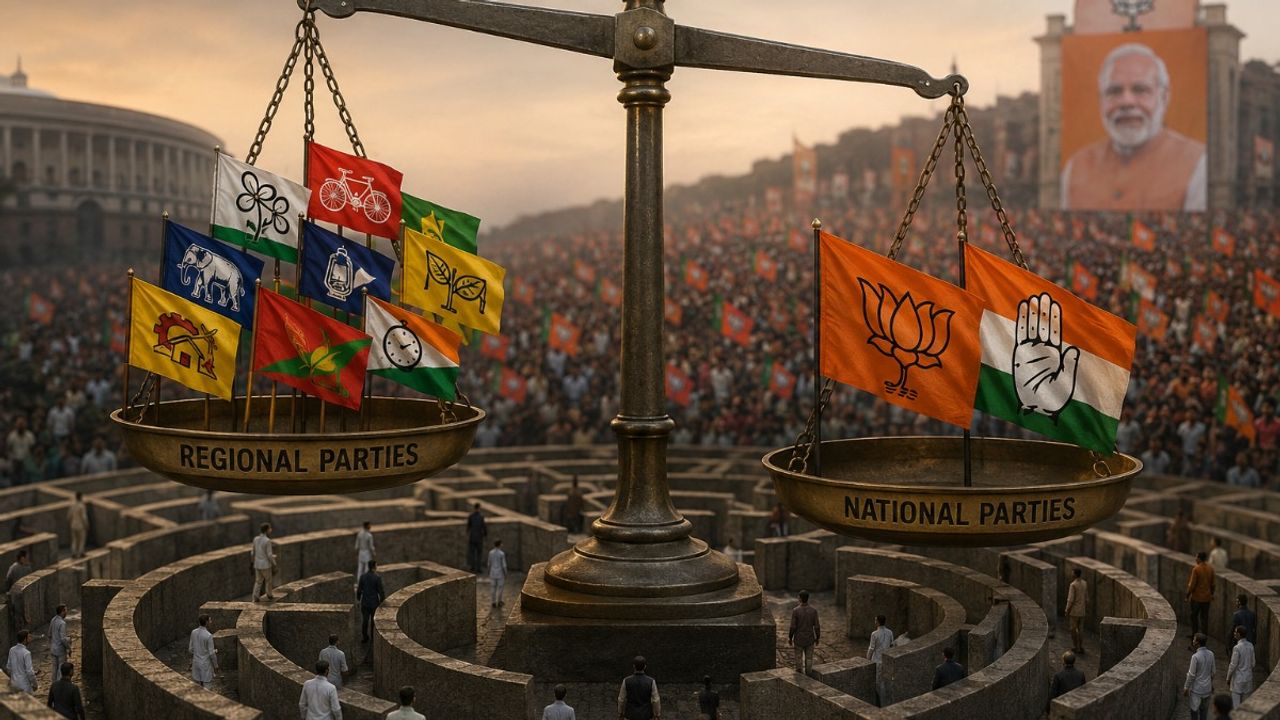
The 2026 verdicts left regional parties governing on their own in as few states, the fewest in about 25 years, and 2029 now looks like a contest between the BJP-led NDA and a Congress-led opposition bloc. A dominant centre makes it harder for regional parties to bargain and survive. But it kills them only when the regional party is also weak at home. Parties like the TDP, which managed succession, and the TVK show that a regional party with fresh leadership and a local grievance can still win.
The map has narrowed
The May verdicts were harsh on
incumbents and harsher on regional parties leadership. In West Bengal the BJP won more
than 200 of 294 seats and ended 15 years of Trinamool rule. In Tamil Nadu the
DMK lost power to Vijay's TVK. In Kerala the Left lost to the Congress-led UDF,
leaving it without a state government anywhere in India. Earlier setbacks for
the BJD, BRS and YSRCP, and AAP's loss of Delhi, had already thinned the field.
The arithmetic is stark. By one count regional parties independently head four state governments, down from
nine between 2015 and 2020. Another tally, as of August, finds only few states,
Andhra Pradesh, Tamil Nadu, Meghalaya, Jharkhand and Nagaland. The regional
parties that survive in office, such as the TDP, mostly do so as partners of a
national party.
The national picture follows.
After a reduced tally of 240 seats in 2024, the BJP has used a run of state
wins to regain momentum, and Congress has revived in Kerala and remains
competitive in Punjab, Karnataka and Telangana. Political scientist Rahul Verma
has described 2024 as a temporary setback for the BJP rather than a turning
point
The succession problem
Part of the squeeze is internal.
Most of these parties were built around one leader and a family, and 2026
showed what happens when the leader ages, the heir is contested or office is
lost. Age explains some cases. It explains little in others: AAP and the YSRCP
are led by younger men and still struggled.
The oldest leaders have the least
settled successions. Naveen Patnaik of the BJD, now 80, was re-elected
president for a ninth term amid dissent and defections, with no clear heir.
Sharad Pawar, about 85, saw the NCP thrown into a vacuum by Ajit Pawar's death
in January, and the party now faces merger talk and rival claims from Sunetra
Pawar and Supriya Sule. Mayawati, about 70, has removed her nephew Akash Anand
from party roles again just as UP's election season begins.
Elsewhere an heir exists but is
contested. M K Stalin of the DMK, about 73, has made son Udhayanidhi Leader of
the Opposition, so the succession is settled but untested in victory. Mamata
Banerjee of the TMC, about 71, faces a revolt over her nephew Abhishek Banerjee
and an exodus of leaders after the rout. In the BRS, K Chandrashekar Rao, about
72, watched his daughter Kavitha launch her own party in April, while KTR and
Harish Rao compete for the succession.
Younger leaders have their own
troubles. Six MPs moved from Uddhav Thackeray's Shiv Sena (UBT) to the Shinde
camp, and Uddhav, about 66, reportedly offered to step down as chief. Arvind
Kejriwal's AAP, led by a man of about 58, has seen defections, including six
MPs reportedly in Punjab, and now depends on the one state it still governs.
Bihar is mid-transition on both
sides. Nitish Kumar of the JD(U), about 75, has decided to step down as chief
minister and move to the Rajya Sabha, a move that to give the BJP its first
chief minister in the state. His son Nishant Kumar, 50, has formally joined the
party, and the JD(U) is projecting him as the next leader. The RJD, headed by
Lalu Prasad, about 78, named son Tejashwi Yadav working president in January,
but his sister Rohini Acharya attacked him publicly the same day, and her
brother Tej Pratap backed her.
Two southern parties show
different paths. The TDP has managed an orderly handover: Chandrababu Naidu,
76, made son Nara Lokesh, 43, national working president in April, while moving
some senior leaders to symbolic roles. The JD(S) has the oldest face of any
party: H D Deve Gowda is 93 and undergoing dialysis, his grandson Prajwal
Revanna is in jail, and the party's hopes rest on his son H D Kumaraswamy, now
a Union minister, and grandson Nikhil Kumaraswamy, who heads the youth wing.
The Samajwadi Party is the
exception. Akhilesh Yadav, about 53, leads the largest party in Uttar Pradesh
after 2024, and its leadership is not in question; his difficulty is
seat-sharing with the Congress. The Akali Dal is the deepest case. Its vote
share fell from 41.91 per cent in 2012 to 18.38 per cent in 2022, and its seats
from 68 to three. Sukhbir Badal, about 64, has faced a rebellion led by his
brother-in-law Bikram Majithia and now competes for Panthic votes with the new
Akali Dal (Waris Punjab De). The YSRCP's Jagan Mohan Reddy, about 53, has lost
MPs and MLCs since the 2024 defeat.
The common thread is that
succession is hardest to manage once a party is out of power and defecting is
cheap. The caveat is that the BJP and the Congress also lean heavily on a few
central leaders.
What 2029 will turn on
So, is 2029 mainly BJP versus
Congress? At the level of national narrative, probably yes. The BJP's
leadership has already predicted a fourth straight defeat for Congress, and
Rahul Gandhi has countered that the opposition has "already won"; both
are campaign claims, not forecasts. India is not becoming Britain or America.
It is becoming a country with two gravitational centres and many satellites.
The parties that keep their own orbit, by renewing leaders and organizations,
will decide whether 2029 is a two-horse race or the old coalition arithmetic in
new clothes.
How do you feel about this story?
Discussion
No comments yet. Be the first to share your thoughts.
Join the discussion
Sign in to share your thoughts on this story.