BNN Summary
Recent statements by Shiv Sena (UBT) leader Sanjay Raut and former Rajasthan Chief Minister Ashok Gehlot have rekindled discussions about the historical success of Congress breakaway factions versus the general failure of BJP rebels. This trend, highlighted by Raut's call for regional parties with Congress roots to merge back, reflects deep-seated differences in the organizational ethos, ideological breadth, and leadership structures of India's two largest national parties. The divergence in outcomes for these internal revolts offers crucial insights into their political resilience and adaptability over decades.
In-Depth Analysis
The Indian political landscape is once again abuzz with introspection on the nature of party loyalty and dissent, particularly concerning the distinct fates of rebel factions from the Indian National Congress (INC) and the Bharatiya Janata Party (BJP). This renewed discussion follows remarks from Shiv Sena (UBT) leader Sanjay Raut, who recently advocated for regional parties that originated from the Congress to reintegrate into the parent party to form a stronger opposition against the BJP. Raut's suggestions, supported by Congress leader Ashok Gehlot, underscore a historical observation: Congress breakaways have often found sustained success, while BJP rebellions have largely dissipated. [13, 14, 17, 18]
Union Minister Hardeep Singh Puri's firm stance on any potential alliance between the BJP and the Shiromani Akali Dal (SAD) in Punjab further illustrates the BJP's evolving strategy and self-perception. Puri asserted that the BJP would no longer tolerate a 'junior partner' role, emphasizing the party's significantly stronger political position and expanded organizational base in the state. [5, 6, 8, 11] He reflected on past alliances, stating that the BJP's previous limitation to only 23 out of 117 assembly seats in Punjab was 'counterproductive' for its growth. [6, 8, 11] This highlights the BJP's current drive for dominance, contrasting sharply with the Congress's historical experience of accommodating and often losing ground to its splinter groups.
The Indian National Congress, a foundational political entity established in 1885, has a long and intricate history of internal divisions, with schisms accelerating post-independence. [3] These ruptures, peaking between 1960 and 2000, have contributed significantly to India's multi-party system, with over 118 documented splinter entities emerging from the INC alone. [3] Many of these breakaway parties have thrived, inheriting organizational networks and voter bases. Key factors for these splits included entrenched factionalism, leadership rivalries, and tensions over centralized authority versus regional or ideological autonomy. [3]
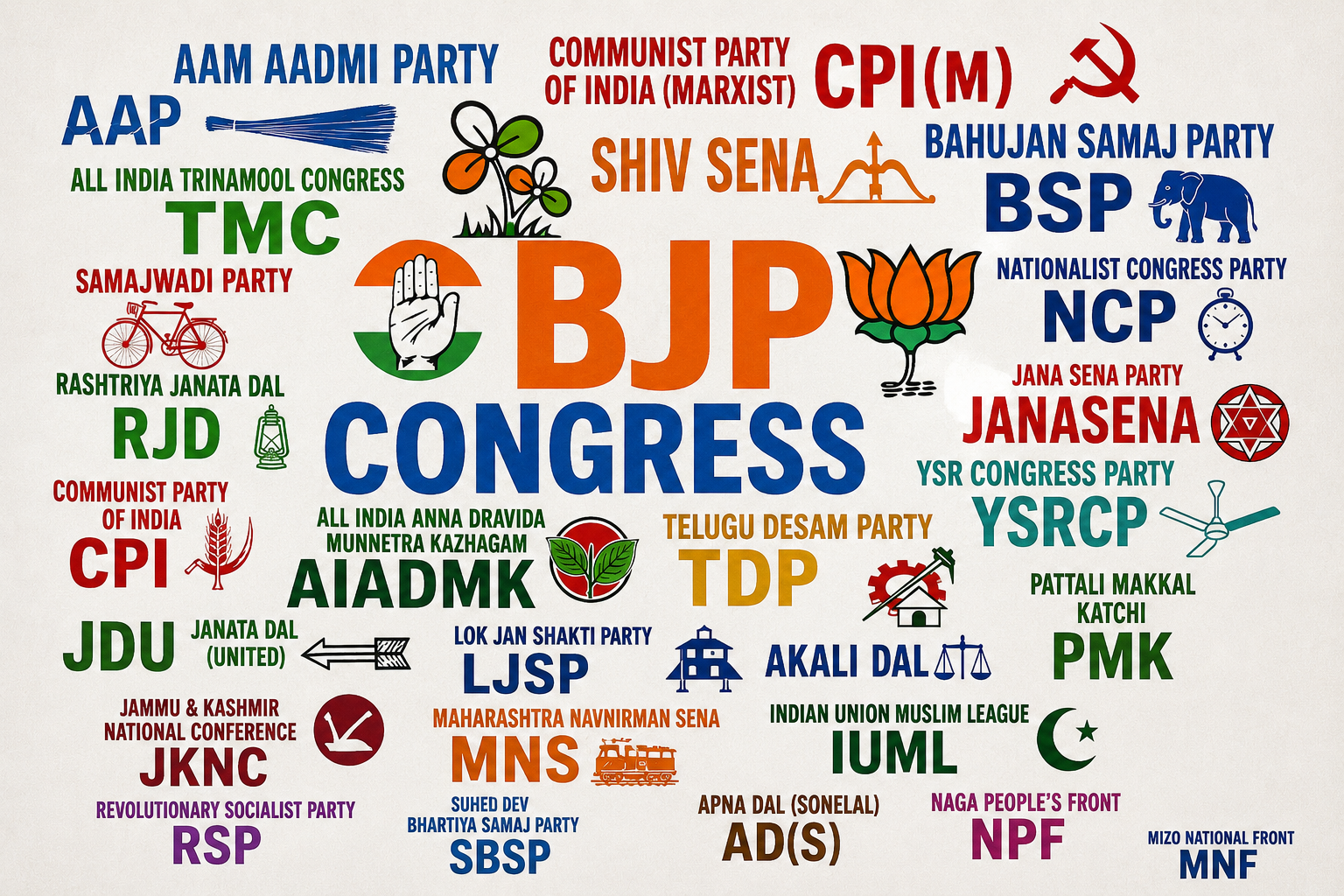
Notable examples of successful Congress breakaways include the Nationalist Congress Party (NCP), founded by Sharad Pawar in 1999 over differences concerning Sonia Gandhi's foreign origin. [3, 10] Despite initial vote splitting in Maharashtra, the NCP established itself as a major regional force. [3, 10] Similarly, the Trinamool Congress (TMC), formed by Mamata Banerjee in 1998 after her expulsion from the Congress, decimated the parent party in West Bengal, eventually reducing it to near-irrelevance in the state. [3, 15] Other successful offshoots include the YSR Congress Party in Andhra Pradesh, formed by Jagan Mohan Reddy in 2011 after perceived sidelining by the Congress high command following his father's death. [10] Earlier instances like the Swatantra Party (1959) and the Congress (Organisation) in 1969, which later merged into the Janata Party and even formed India's first non-Congress government under Morarji Desai, also demonstrate the viability of Congress splinter groups. [3, 19]
The Congress's ideological breadth, often described as a 'big tent' party accommodating diverse viewpoints, paradoxically made it susceptible to splits. Leaders with strong regional bases or distinct ideological leanings found it easier to leave and establish their own outfits, often retaining a significant portion of the original party's supporters and cadres. The anti-defection law, while intended to curb individual defections, inadvertently encouraged the formation of regional parties by groups of legislators. [10] This historical pattern has significantly weakened the Congress's electoral base and fostered the rise of numerous regional powerhouses. [3]
In stark contrast, rebellions within the Bharatiya Janata Party have typically met with limited success. The BJP's tightly-controlled organizational structure, strong central leadership, and a more defined ideological core rooted in Hindutva generally make it harder for rebels to gain traction. The party's disciplined cadre base, often linked to the Rashtriya Swayamsevak Sangh (RSS), provides a robust internal mechanism that often stifles dissent or quickly marginalizes those who rebel. The BJP's model, unlike the Congress's more amorphous structure, relies heavily on a top-down command, making sustained independent rebellion challenging. [27, 28]
While specific instances of dissent and leaders leaving the BJP exist, they rarely translate into successful, long-lasting political parties capable of challenging the BJP's dominance. For example, former Gujarat Chief Minister Keshubhai Patel formed the Gujarat Parivartan Party (GPP) in 2012 but it performed poorly and eventually merged back into the BJP. Similarly, B.S. Yeddyurappa, a prominent BJP leader in Karnataka, formed the Karnataka Janata Paksha (KJP) in 2012 but later returned to the BJP. These instances demonstrate that while individual leaders may temporarily split, the BJP's core electoral machinery and ideological appeal often prove too strong for such breakaway groups to sustain themselves. [29]
The BJP's 'Congress-mukt Bharat' (Congress-free India) slogan, first articulated in 2014, reflects its ambition to not just defeat but diminish the Congress's political space. [30] However, ironically, the success of Congress breakaways has often contributed to this fragmentation, creating a complex web of regional parties that the BJP now seeks to either absorb or neutralize. Hardeep Puri's recent remarks exemplify this ambition, asserting the BJP's readiness to play a dominant role rather than a subordinate one in alliances. The history of political revolts in India thus serves as a powerful indicator of the differing institutional strengths and vulnerabilities of its major political parties.
How do you feel about this story?