BNN Summary
Former Trinamool Congress (TMC) MP Sushmita Dev has clarified her departure from the party, stating her decision was driven by a desire to contribute to Assam's development, not by Mamata Banerjee's electoral setbacks. Dev lauded the Bharatiya Janata Party's (BJP) significant developmental strides in Assam over the past decade, signaling a potential shift in her political allegiance and a renewed focus on her home state's progress.
In-Depth Analysis
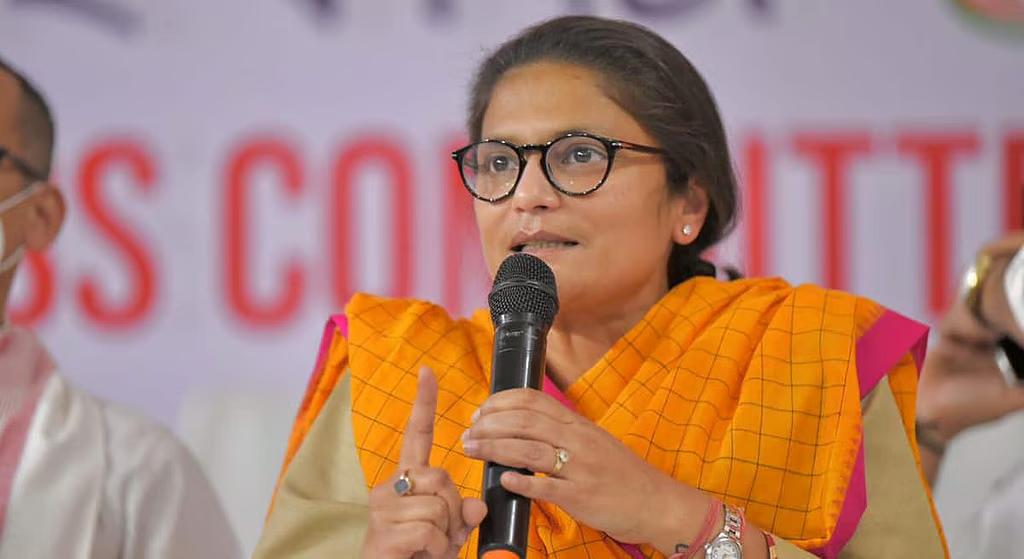
In an exclusive interview, former Trinamool Congress (TMC) MP Sushmita Dev has offered crucial insights into her recent high-profile exit from the TMC, firmly refuting speculations that her departure was linked to the electoral performance of West Bengal Chief Minister Mamata Banerjee. Dev articulated that her primary motivation stems from a profound desire to actively engage in the developmental trajectory of Assam, her home state, expressing a clear intention to dedicate her efforts to its progress. 'I want to work in Assam, I didn't quit TMC because Mamata lost,' Dev stated emphatically, drawing a distinct line between her personal political aspirations and the broader national political narrative. This statement provides a definitive clarification amidst widespread conjecture following her resignation from the Rajya Sabha and the TMC.
Her move, which saw her leave the Trinamool Congress, a party she joined after a significant stint with the Indian National Congress, marks a pivotal moment in her political career. Dev, who had served as a Member of Parliament in the Rajya Sabha representing the TMC, emphasized that her decision was not a reaction to any political defeat or a sign of discontent with the TMC's leadership or ideology, but rather a proactive step towards what she perceives as a more impactful role in regional politics. Her focus, she reiterated, is now squarely on the socio-economic advancement of Assam.
Adding another layer of significance to her statements, Dev openly acknowledged and praised the developmental efforts undertaken by the Bharatiya Janata Party (BJP) in Assam. She highlighted what she described as 'remarkable development' achieved by the BJP government in the state over the past decade. This commendation of the BJP's work is particularly noteworthy given her background with opposition parties, suggesting a pragmatic assessment of governance and progress rather than strict party-line adherence. Her endorsement of the BJP's tenure in Assam indicates a potential alignment with the ruling party's vision for the northeastern state, or at the very least, an appreciation for the tangible changes on the ground.
Assam has indeed witnessed substantial investment and focus from the central government, particularly in infrastructure, connectivity, and industrial development, which the BJP often champions as its key achievements in the region. Dev's observations resonate with the narrative put forth by the BJP regarding its commitment to the Northeast, often referred to as the 'Act East' policy's gateway. Her comments could be interpreted as an acknowledgement of these tangible outcomes, irrespective of political affiliations.
This shift in focus by Sushmita Dev holds considerable implications for the political landscape, both for the TMC and for Assam. For the TMC, it represents the loss of an articulate and prominent national face, especially one with a strong connection to the northeastern region. While the TMC has been aiming to expand its footprint beyond West Bengal, Dev's departure from a significant Rajya Sabha position could be seen as a setback to these ambitions. Her independent stance on her reasons for leaving also challenges any narrative that might suggest internal strife or a direct reaction to electoral outcomes.
For Assam, Dev's expressed desire to work within the state, coupled with her positive remarks about the BJP's governance, could signal a new phase in her political engagement. Given her experience as a former MP and her deep roots in the region, her renewed focus on Assam has the potential to influence local political dynamics. Whether this will translate into a formal association with the BJP or a role independent of established party structures remains to be seen, but her statements unequivocally point towards a future dedicated to the welfare and progress of Assam. Her emphasis on development over political rivalry might set a precedent for other regional leaders to prioritize state-specific agendas, contributing to a more nuanced and development-centric political discourse in the Northeast.
The broader context of her decision also reflects a growing trend where regional aspirations and local development priorities are increasingly influencing political decisions, sometimes transcending traditional party loyalties. Sushmita Dev's move underscores the evolving nature of Indian politics, where leaders are often compelled to respond to the specific needs and perceived progress of their home states.
How do you feel about this story?