BNN Summary
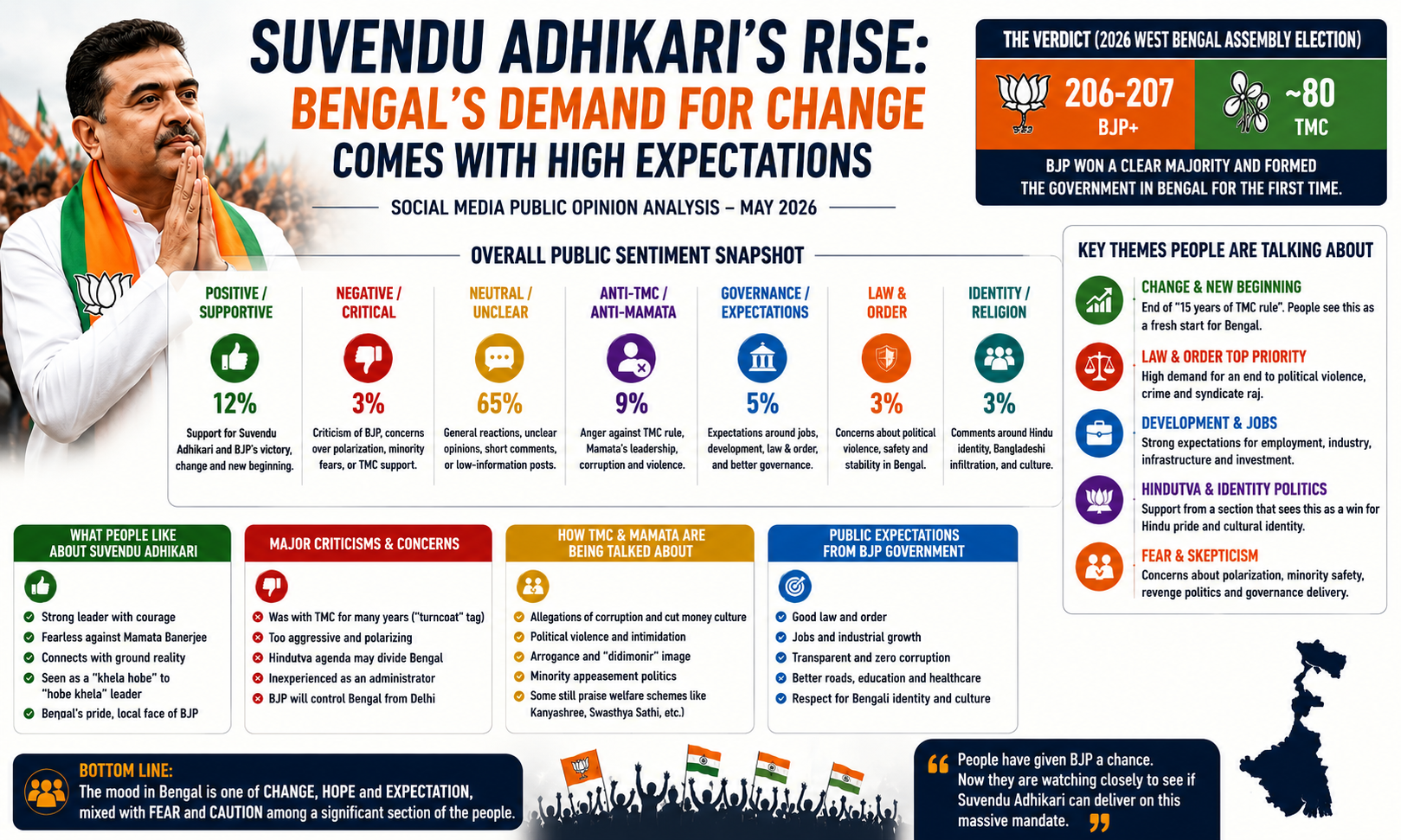
Suvendu Adhikari’s rise as Chief Minister reflects Bengal’s strong desire for political change after years of TMC dominance. But public support now comes with high expectations for better governance, law and order, jobs, and stability.
In-Depth Analysis
A Clear Shift in Bengal’s Political Mood
Public opinion around Suvendu Adhikari and the BJP shows a strong desire for political change in West Bengal. Many people see Suvendu as a leader who directly challenged Mamata Banerjee and became the face of BJP’s rise in the state. The mood is not only about celebrating a party victory; it is also about ending a long period of TMC dominance. For many supporters, Suvendu represents courage, local leadership, and a new political direction for Bengal.
This shift is important because Bengal politics has been dominated by strong personalities and long-ruling parties for many years. People who support Suvendu seem to believe that Bengal needs a leader who can break the old style of politics and bring a different approach. His rise is being seen as a sign that voters are willing to try a new political force if they feel the current system has failed them. At the same time, this support comes with responsibility, because people are not just looking for a new face—they are looking for real change in governance, safety, and development.
Support Built on Anti-TMC Sentiment
A major reason behind the positive response to Suvendu and BJP is anger against the TMC government. Around 9% of the public reactions show direct anti-TMC or anti-Mamata sentiment, while around 12% clearly support Suvendu or BJP. Many people talk about issues like political violence, corruption, arrogance in power, and the need to end “cut-money” culture. This shows that BJP’s support is not only based on party loyalty; it is also driven by frustration with the previous ruling system.
For many people, the support for Suvendu is linked to the feeling that Bengal needed a political reset. The criticism of TMC is not limited to one issue. It includes anger over local-level control, alleged misuse of power, political intimidation, and dissatisfaction with how the state was managed. This anti-TMC sentiment helped create space for BJP to grow. However, this also means BJP must be careful. If people supported BJP mainly because they were unhappy with TMC, then the new government will have to prove very quickly that it can offer something better, not just something different.
Suvendu’s Strength: Fighter Image and Local Connect
Suvendu’s biggest political strength is his image as a fighter. Many people admire him because he took on Mamata Banerjee directly and became the main face of BJP in Bengal. Unlike a leader seen only as a party representative, Suvendu is being viewed as someone with ground-level experience and local political understanding. This gives him a personal advantage. However, this same image also creates pressure, because people now expect him to act quickly and strongly as a leader.
His local connect also matters a lot. Bengal voters often value leaders who understand the ground reality, local culture, and regional political emotions. Suvendu is not being seen as an outsider; he is being seen as a Bengal leader who knows the political system from inside. His past experience in TMC may be used by opponents to call him a turncoat, but supporters may see the same experience as an advantage because he understands how the old system worked. The challenge for him is to convert his image as a strong opposition fighter into the image of a stable and fair administrator.
Concerns Around Polarization and Governance
Even though the overall mood is favorable, there are important concerns. Around 3% of reactions show direct doubt, criticism, or pro-TMC/anti-BJP feeling, while another section focuses on law-and-order worries. Some people fear that politics in Bengal may become more polarized, especially around religion and identity. Others are asking whether BJP can actually improve governance, create jobs, stop political violence, and bring stability. This means people are not only looking for a change in party; they are looking for a change in the style of governance.
These concerns should not be ignored, because they show what people are nervous about. A section of the public wants strong action, but another section fears that strong action may turn into revenge politics or social division. This is where Suvendu’s leadership will be tested. If the new government focuses only on political victory, it may lose the trust of neutral voters. But if it focuses on law and order, fair treatment, job creation, and transparent administration, it can reduce fear and build wider public confidence.
What People Expect From the New Government
The strongest expectation from Suvendu and BJP is delivery. People want better law and order, less corruption, more jobs, industrial growth, and safer politics. They also want the government to protect Bengal’s culture while avoiding unnecessary political revenge. The victory mood gives BJP an advantage, but it will not last forever without performance. Suvendu’s challenge is to move from campaign-style aggression to responsible administration.
People will likely judge the government on visible results. They will want to see whether political violence reduces, whether local corruption is controlled, whether police and administration act fairly, and whether new investment comes into the state. Youth expectations will also be high, especially around employment and opportunities. For BJP, the first phase of governance will be very important because it will shape public opinion for the future. If the government can show discipline, development, and stability early, it can turn election support into long-term trust.
How do you feel about this story?