BNN Summary
When the U.S.–Israel strikes on Iran began on Feb 28, 2026, the war didn’t stay on the battlefield. It quickly spilled into timelines—where millions of people tried to understand the…
In-Depth Analysis
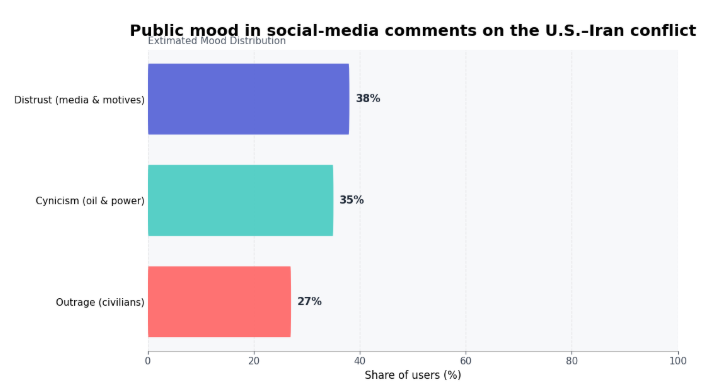
When the U.S.–Israel strikes on Iran began on Feb 28, 2026, the war didn’t stay on the battlefield. It quickly spilled into timelines—where millions of people tried to understand the same events, but started from very different moral positions. Some framed it as “self-defense.” Others called it an “invasion.” Many didn’t begin with morality at all—they began with fuel prices, trade routes, and raw power. On social media, you don’t find one public opinion. You find three big public moods arguing with each other every minute—outrage, cynicism, and distrust. Each mood has its own logic, its own villains, and its own “proof.” And each mood grows stronger because modern wars are fought in two places at the same time: in real life and in information.
Mood 1: Outrage — “If you can hit leaders, why are children dying?”
The strongest emotional reactions are about civilians. People hear the words “precision strikes,” and they ask a blunt question: If the system can track leaders so accurately, how can a school be destroyed? How can hospitals be damaged? This outrage becomes sharper when people believe that civilian sites were not accidental “near misses,” but part of a larger pattern—especially when they see repeated images of damaged medical buildings, injured children, and frightened families. In the comments you shared, the same idea comes up again and again: If you can choose the exact building, you can also choose not to hit the wrong one. From there, social media becomes a moral courtroom. One side treats civilian harm as proof that powerful militaries talk about “precision” while tolerating tragedy. Another side argues that civilian harm is “collateral,” or blames the defender for placing military assets near civilian areas. Either way, civilian suffering becomes the strongest argument online, because it cuts through ideology and hits the gut. A major fear inside this mood is what comes next. Many commenters warn that civilian deaths don’t end conflicts—they extend them. People say that every destroyed home, every hospital hit, and every child killed creates more anger, more revenge, and more long-term instability. In simple terms: today’s strike becomes tomorrow’s recruit.
Mood 2: Cynicism — “Say no more: oil.”
In the explainer-type comment set, many viewers reduce the entire story to one word: oil. Their logic is simple: where there is oil, powerful countries interfere; where there is interference, there is blood; and history repeats. This mood pulls history into the present. Commenters repeatedly point to earlier foreign interference, old power deals, and past regime-shaping as the “origin story” for today’s hostility. Even when users disagree on details, their conclusion is similar: strategic interests are presented as moral missions. The language may change—security, stability, peace—but the suspicion stays the same: follow the money. This cynicism becomes louder when the war begins to affect daily life far from the region. The moment fuel prices rise and markets shake, the oil argument feels “proved” to many people. It stops being a theory and becomes a lived experience: war → disruption → higher prices → ordinary people suffer. At the same time, there is a smaller counter-thread inside this mood. Some commenters push back and say: it’s not only oil. They point to ideology, nuclear fear, regional influence, and proxy networks. That debate matters because it shows the internet is not one voice—it’s a fight between “simple explanation” and “complex explanation.” But even many of the “complex” voices still agree that oil and control are part of the picture.
Mood 3: Distrust — “Media is propaganda, and leaders are hiding the truth.”
The loudest shared emotion across all your comment sets is not love for Iran or hatred for the U.S. It is distrust. People distrust official claims of success. They distrust casualty numbers. They distrust “damage assessments.” They distrust carefully edited video clips and dramatic briefings. And they distrust mainstream coverage too—some accuse it of hiding civilian suffering; others accuse it of exaggerating it; many say it shows only what fits a narrative. That’s why so many comments demand “show the other side too.” It’s why satellite images become a battleground. It’s why “leaks” are treated as proof that someone is lying. In a trust-collapsed environment, even true information gets doubted, because people assume it was chosen for a reason. This distrust grows even stronger when the war hits wallets. As energy prices rise and shipping routes become uncertain, people start connecting everyday pain to political decisions. And once that connection is made, suspicion spreads quickly: If they are not honest about the war, why would they be honest about the cost? In this mood, people don’t debate calmly. They choose labels: “forever war,” “regime change,” “invasion,” “self-defense,” “human shields,” “war crimes.” And once they choose a label, they treat opposite facts as propaganda. Social media rewards certainty, not caution—so the loudest, simplest story often wins.
The hidden center: “Stop the war”
Under the shouting, there is a quieter line that repeats across all sets: stop the war. It appears as prayer, exhaustion, and fear of escalation. It appears to worry about families trapped in conflict zones. It appears as fear that this could spiral into something larger than anyone can control. This is the most human thread, and also the easiest to miss—because it doesn’t shout as loudly as blame or celebration.
The clearest social-media verdict so far
Put these moods together and the internet delivers one verdict again and again: People may disagree on Iran, Israel, or America—but a huge number agree on one thing: they don’t trust the story they’re being told. That is the internet’s war: not only a fight over territory and missiles, but a fight over credibility—who is lying, who is hiding, who is profiting, and who is paying. And until people feel they are being told the truth—about civilian harm, about costs, and about goals—public opinion will remain loud, divided, and combustible, even if the shooting slows down
How do you feel about this story?