BNN Summary
Prime Minister Narendra Modi has highlighted the Bharatiya Janata Party's dedication to a 'Nation-First' political philosophy, linking the historic abrogation of Article 370 to the long-standing vision of Jana Sangh founder Dr. Syama Prasad Mookerjee.
In-Depth Analysis
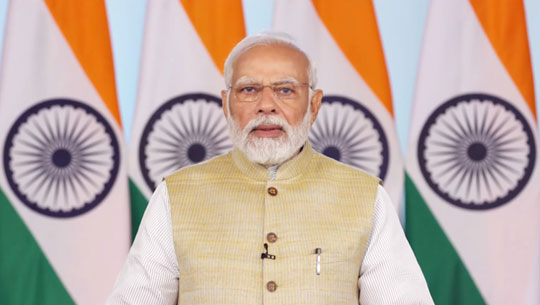
Prime Minister Narendra Modi recently underscored a significant ideological shift in the Indian political landscape, asserting that the Bharatiya Janata Party (BJP) has successfully established a new principle centered entirely on the 'Nation-First' doctrine. During his address, the Prime Minister reflected on the legacy of Dr. Syama Prasad Mookerjee, the founder of the Bharatiya Jana Sangh, noting that the revocation of Article 370 in Jammu and Kashmir was a pivotal realization of Mookerjee's lifelong dream for a unified and integrated India.
The Vision of Dr. Syama Prasad Mookerjee
Dr. Syama Prasad Mookerjee is remembered by the party as a visionary who sacrificed his life to ensure that India remained an indivisible entity. His famous slogan, 'Ek desh mein do Vidhan, do Pradhan, aur do Nishan nahi chalenge' (There cannot be two constitutions, two prime ministers, and two flags in one nation), continues to serve as the bedrock for the BJP's nationalistic policies. The Prime Minister noted that the current government's move to remove the special status of Jammu and Kashmir was the ultimate tribute to Mookerjee's efforts to bring the region fully into the national fold.
Expanding Political Discourse
The sentiment was echoed across various states as the BJP commemorated the 125th birth anniversary of Mookerjee. In Bengaluru, Karnataka BJP members held floral tributes, while Uttar Pradesh Chief Minister Yogi Adityanath praised Mookerjee for his role in preserving the integrity of Bengal. Adityanath specifically highlighted Mookerjee's efforts during the partition era, crediting him with saving Bengal from what he described as the 'bloody clutches of Pakistan'. These tributes across the country were not merely ceremonial; they served as a coordinated effort to reinforce the BJP's historical narrative and its adherence to the 'Nation-First' principle.
National Integration as a Political Principle
Prime Minister Modi articulated that the BJP's governance model is distinct because it prioritizes long-term national interest over short-term electoral gains. By addressing legacy issues that had persisted for decades, such as the constitutional ambiguity surrounding Jammu and Kashmir, the administration aims to demonstrate that political willpower is the key to national security and internal cohesion. This approach has become the hallmark of the current administration's strategy, moving from reactive governance to proactive structural reform.
Legacy and Future Outlook
The continued emphasis on Mookerjee’s ideology signifies the BJP's intent to keep nationalist discourse at the forefront of its political agenda. By framing the abrogation of Article 370 as a fulfillment of a historical promise, the party not only honors its founding members but also validates its current political trajectory. As the party moves forward, the 'Nation-First' principle remains the guiding light for its legislative and developmental goals, ensuring that the legacy of leaders like Mookerjee remains relevant in the modern era of Indian politics. The leadership remains steadfast in its belief that historical wrongs must be corrected to secure the future of the nation for generations to come.
How do you feel about this story?
Discussion
No comments yet. Be the first to share your thoughts.
Join the discussion
Sign in to share your thoughts on this story.