

BNN Summary
What further diminished the credibility of the anti-SIR agitation was the ideological framing adopted by prominent figures and commentators associated with the broader movement. Rather than anchoring their critique entirely within domestic constitutional norms, several vocal activist factions drew explicit comparisons to external political upheavals. Until opposition parties pivot away from sensationalist posturing and re-anchor their strategy in grassroots, issue-based governance, hyper-localized agitations will continue to boomerang—further solidifying the government's political advantage.
In-Depth Analysis
In the landscape of modern Indian politics, street mobilizations have long served as a double-edged sword. When grounded in organic, widespread public anxiety—such as the nationwide fervor surrounding the NEET examination irregularities—protests can rapidly galvanize cross-party solidarity and force policy recalibration. However, when demonstrations remain hyper-localized, reliant on institutional technicalities, and framed through radical or foreign-inspired rhetoric, they risk achieving the exact opposite of their intended goal.
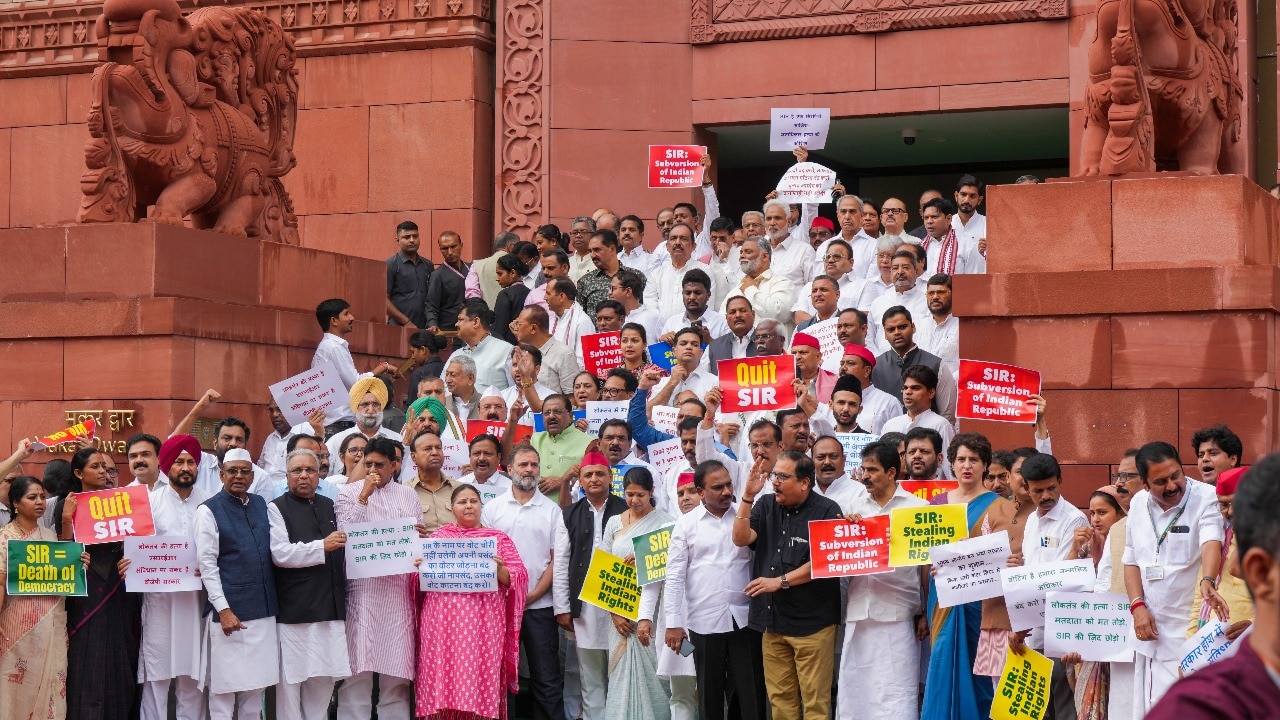
The recent opposition-backed demonstrations against the Election Commission of India’s (ECI) Special Intensive Revision (SIR) process present a textbook case study of an agitation that failed to capture the national imagination. Despite high-decibel media coverage around central corridors in New Delhi, the movement struggled to expand beyond a few arterial roads in the capital, exposing deep structural flaws in the opposition’s narrative building and strategic execution. SIR involves electoral-roll verification, duplicate entries, deceased voters, shifted voters, documentation and appeals. These are technical issues. The Opposition’s message may struggle when it focuses on institutional allegations without explaining, in simple terms, how a particular eligible voter was wrongly excluded and what remedy is needed.
Localized Friction vs. The NEET Parallel
To understand why the anti-SIR protests failed to generate a countrywide groundswell, one must compare their core mechanics with the NEET agitations. The NEET issue struck at the heart of millions of middle-class households. Education, competitive fairness, and youth aspirations are universal concerns that transcend regional, linguistic, and ideological divisions. A parent in Chennai, a student in Kota, or a family in Patna felt an immediate, tangible stake in the integrity of nationwide entrance testing.
In stark contrast, the opposition’s pushback against the SIR process—an administrative revision of electoral rolls— struggled to cross the threshold of abstract political commentary. While opposition parties framed the roll updates as systemic exclusion, the average voter viewed electoral roll maintenance as a standard procedural exercise. Outside of central Delhi's political enclosures near Jantar Mantar and Parliament, life across tier-2 cities, rural belts, and southern and eastern hubs proceeded uninterrupted. Lacking an organic, personal connection to the daily lives of citizens, the stir remained an artificial, top-down mobilization rather than a spontaneous mass movement.
The Narrative Trap: Foreign Analogies and Radical Rhetoric
What further diminished the credibility of the anti-SIR agitation was the ideological framing adopted by prominent figures and commentators associated with the broader movement. Rather than anchoring their critique entirely within domestic constitutional norms, several vocal activist factions drew explicit comparisons to external political upheavals.
When student leaders like AISA’s Neha Bora or allied youth organizations invoked foreign revolutions—such as referencing the Gen Z-led uprisings in neighboring Bangladesh that ousted the ruling regime—it created an immediate optics problem. To the broader Indian electorate, equating routine electoral list audits in a robust constitutional democracy with extra-institutional regime changes in neighboring nations signals a disregard for democratic norms.
Similarly, the heavy involvement of diaspora commentators and foreign-based influencers—such as Germany-based commentator Dhruv Rathee or international political actors like Elon Musk—invoking sweeping ultimatums against the elected government created significant friction. Historically, the Indian public bristles at external commentary or foreign-diaspora elements attempting to lecture domestic democratic institutions. When overseas commentators urge extreme actions or appeal to institutional forces against a democratically elected administration, it triggers an instant nationalistic counter-reaction.
Furthermore, policy paradoxes within opposition discourse—such as key political figures attempting to align with global corporate elites like Elon Musk while simultaneously adopting anti-establishment political stances—created ideological incoherence. Rather than presenting a clear, unified vision, these mixed signals alienated voters who seek consistency and grounded leadership.
How Miscalculated Protests Backfire on the Opposition
For political coalitions attempting to build an alternative to the ruling National Democratic Alliance (NDA), relying on localized disruptions combined with radical imagery presents severe electoral risks:
Daily Disruption Alienates the Urban Middle Class: Concentrating protests along major thoroughfares in central Delhi directly inconveniences working-class commuters, officegoers, and local business owners. Instead of building sympathy, traffic gridlocks and street blockades foster irritation toward the organizers.
Activating the Sovereign Voter Base: By invoking foreign revolts, relying on overseas commentators, or seeking external validation, the opposition inadvertently hands a massive advantage to the ruling dispensation. The government can easily pivot the narrative away from electoral roll technicalities and frame the debate as a defense of national sovereignty against vested, foreign-aligned interests.
Institutional Fatigue: Continual attacks on democratic bodies like the ECI or judiciary—without offering undeniable, universally recognized proof—risk alienating moderate voters who value institutional stability over perpetual political friction.
Why the Opposition Is Losing Ground
The trajectory of the anti-SIR stir illustrates a larger pattern in contemporary Indian politics: the opposition bloc is increasingly losing ground by mistaking high-decibel Delhi activism for broad electoral strategy.
In modern elections, voter loyalty is secured through quiet, sustained organizational work: booth-level voter outreach, clear policy messaging, local leadership development, and tangible governance alternatives. When an opposition party prioritizes short-lived media cycles in the capital over grassroots expansion in rural and semi-urban belts, it creates a vacuum that the ruling party's electoral machinery readily fills.
A political strategy defined almost exclusively by negation—focusing on what to obstruct rather than what to build—fails to construct a reliable voting coalition. When protests are perceived as being driven by political survival or external influence rather than genuine public distress, they erode the opposition's credibility.
Street protests remain a fundamental instrument of democratic expression, but their efficacy depends entirely on public resonance and moral clarity. The anti-SIR demonstrations, restricted to a few corridors in Delhi and weighed down by foreign revolutionary analogies, failed to emulate the organic momentum of agitations like NEET. Until opposition parties pivot away from sensationalist posturing and re-anchor their strategy in grassroots, issue-based governance, hyper-localized agitations will continue to boomerang—further solidifying the government's political advantage.
Dr K. Venkatakrishna Rao, Assistant Professor, NIT Warangal and Visiting Fellow, India Foundation, New DelhiHow do you feel about this story?
Discussion
No comments yet. Be the first to share your thoughts.
Join the discussion
Sign in to share your thoughts on this story.


