
BNN Summary
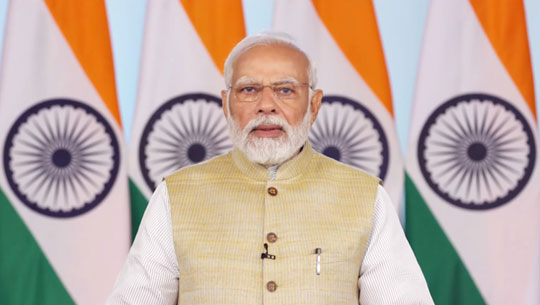
Prime Minister Narendra Modi addressed the India Mobile Congress, emphasizing the transformative journey of Digital India in democratizing technology and bridging the digital divide. He highlighted India's transition from a technology consumer to an innovation creator, domestic intellectual property generation, and called for a global framework against cybercrime.
In-Depth Analysis
Prime Minister Narendra Modi addressed the India Mobile Congress, underscoring the revolutionary impact of the Digital India vision in democratizing technology and effectively bridging the nation's long-standing digital divide. Speaking to a distinguished gathering of global technology leaders, telecom industry executives, policymakers, and international delegates, the Prime Minister highlighted how access to affordable, high-speed digital infrastructure has fundamentally transformed everyday life across both urban centers and remote rural communities.
In his comprehensive address, Prime Minister Modi emphasized that technology in India is no longer an exclusive privilege reserved for a select few, but a powerful instrument of social empowerment and economic inclusion accessible to every citizen. He noted that the government's deliberate policy push toward low-cost data access, extensive telecommunication network expansion, and robust digital public infrastructure has enabled hundreds of millions of citizens to participate directly in the formal digital economy. From seamless digital payments powered by the Unified Payments Interface to real-time direct benefit transfers, telemedicine, and digital education platforms, India's digital public infrastructure has emerged as a respected global model for scalable and equitable innovation.
A central theme of the Prime Minister's speech was India's decisive transition from being a passive consumer of global technology to becoming an active creator of cutting-edge solutions, domestic products, and valuable intellectual property. Prime Minister Modi emphasized that the nation is building a resilient ecosystem that actively supports domestic hardware manufacturing, deep-tech research, indigenous software design, and advanced telecom equipment production. With significant momentum in semiconductor manufacturing, domestic smartphone assembly, and locally developed 5G and future 6G technologies, India is firmly establishing its position as a major contributor to global supply chains and technological standards.
Highlighting the critical challenges accompanying rapid digitalization, Prime Minister Modi issued an urgent call for a comprehensive global framework to tackle cybercrime and safeguard digital ecosystems. He stressed that security threats in cyberspace operate without national borders, making isolated national measures insufficient. The Prime Minister advocated for international consensus on cybersecurity standards, joint counter-cybercrime mechanisms, ethical guidelines for artificial intelligence, and real-time threat intelligence sharing to protect critical national infrastructure, financial networks, and individual privacy.
Looking ahead, the Prime Minister praised the incredible speed of India's nationwide 5G rollout, which stands among the fastest telecom deployments in global history. He encouraged young innovators, tech startups, academic institutions, and global corporations to leverage India's vast talent pool and vibrant entrepreneurial environment. Prime Minister Modi reaffirmed the government's commitment to nurturing deep-tech research, expanding digital literacy, and ensuring that future technological advancements remain safe, sustainable, and centered on human well-being.
How do you feel about this story?
Discussion
No comments yet. Be the first to share your thoughts.
Join the discussion
Sign in to share your thoughts on this story.


