
BNN Summary
The national capital of Delhi experienced severe political tension as a mega rally organized by the opposition INDIA bloc coincided with a contentious protest march by the Bharatiya Janata Party regarding the 1984 anti-Sikh riots. Tensions escalated sharply when opposition workers tore down rival campaign posters, leading to a tense standoff and heightened security deployments across key intersections.
In-Depth Analysis
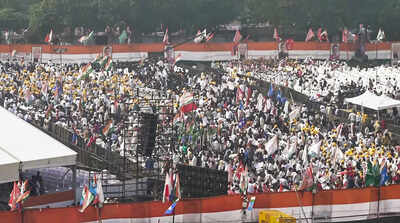
The national capital of Delhi transformed into a high-voltage political theater as rival demonstrations and a major opposition congregation unfolded simultaneously, bringing traffic to a standstill and triggering heated confrontations on the streets. The core of the tension stemmed from a strategic convergence of events, featuring a high-stakes mega rally organized by the opposition INDIA bloc at the historic Ramlila Maidan, which directly coincided with a targeted remembrance march and protest organized by the ruling Bharatiya Janata Party.
The Bharatiya Janata Party had deployed extensive campaign materials across prominent thoroughfares in Delhi, highlighting the historical atrocities of the 1984 anti-Sikh riots. These posters and hoardings sought to remind citizens of the historical accountability of rival parties, particularly the Congress, regarding the communal violence that shook the capital decades ago. The 'Chalo Delhi' posters and visual displays dominated several major junctions, setting an aggressive political narrative that immediately drew fierce reactions from opposing political camps.
As the morning progressed, tensions spilled over into the public domain when groups of workers and sympathizers affiliated with the opposition encountered the provocative display boards. In several high-traffic areas, Congress workers openly engaged in tearing down the Bharatiya Janata Party's posters, citing them as a deliberate attempt to vitiate the atmosphere and derail the messaging of the upcoming opposition mega rally. This direct action led to angry verbal spats, minor scuffles, and chaotic scenes on the roads, forcing law enforcement agencies to intervene rapidly to prevent large-scale violence.
Delhi Police and paramilitary forces were deployed in massive numbers across strategic points, barricading critical routes leading to Ramlila Maidan and the central government enclaves. Despite heavy security cordons, the atmosphere remained volatile throughout the day as thousands of supporters from both sides attempted to assert their political dominance through slogans, flags, and counter-demonstrations. The INDIA bloc rally, which aimed to project opposition unity on a national platform, faced immediate logistical hurdles due to the chaotic street-level disturbances and the deliberate counter-mobilization by the ruling party.
Political analysts noted that the simultaneous occurrence of these events underscores the deepening ideological polarization ahead of upcoming electoral battles. The ruling party utilized the historical grievances of the 1984 riots to counter the narrative of opposition solidarity, while opposition leaders at the Ramlila Maidan focused their addresses on pressing contemporary issues, including democratic institutions, inflation, and unemployment. However, the day will be largely remembered for the raw street politics, torn posters, and the thin line of police personnel that kept rival political armies from descending into full-scale clashes across the capital.
How do you feel about this story?
Discussion
No comments yet. Be the first to share your thoughts.
Join the discussion
Sign in to share your thoughts on this story.


