BNN Summary
A dedicated National Examination Security Command Centre could monitor all major examinations simultaneously, identify vulnerabilities, and coordinate with law enforcement agencies whenever suspicious activity is detected. Public awareness is equally important. Students must understand that purchasing leaked papers is not a shortcut to success but participation in organized crime that destroys meritocracy. Parents, coaching institutes, and educational institutions should actively promote ethical examination practices and discourage any attempt to seek unfair advantage.
In-Depth Analysis
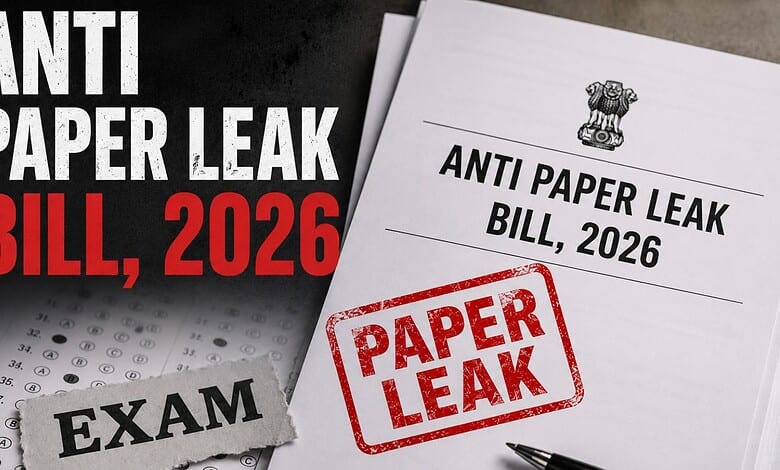
For millions of Indian students, a competitive examination is more than a test—it is the gateway to higher education, government employment, and a better future. Every paper leak not only cancels an examination but also shatters the dreams of honest aspirants who spend years preparing. Recognizing the seriousness of this challenge, Government has strengthened the Public Examinations (Prevention of Unfair Means) Amendment Bill, 2026, introducing tougher punishments, faster investigations, and dedicated fast-track courts to dismantle organized paper leak networks.
The amended legislation significantly strengthens India's anti-cheating framework. It provides for stricter penalties, including imprisonment of up to 10 years and fines that can extend to ₹10 crore for those involved in organized examination fraud. The law also proposes Special Task Forces, time-bound investigations, and Fast-Track Courts to ensure that paper leak cases are investigated and decided without unnecessary delays. The objective is clear: make examination fraud a high-risk crime and restore confidence in India's recruitment and entrance examination system.
This is a welcome and necessary reform. However, strong punishment alone cannot completely eliminate paper leaks. Experience across the world shows that examination integrity depends as much on prevention as on prosecution. India must therefore complement its tough legal framework with robust administrative, technological, and security measures.
India can significantly reduce paper leaks and examination malpractices by gradually transitioning to secure online entrance examinations, similar to international testing systems such as the GRE, GMAT, TOEFL, and SAT. Instead of conducting a single nationwide paper-based examination, the government can establish accredited computer-based testing centres across every district, equipped with biometric authentication, AI-enabled CCTV surveillance, encrypted question paper delivery, secure browsers, and real-time monitoring. Question papers can be generated dynamically from a large question bank, ensuring that each candidate receives a unique set of questions with the same level of difficulty, thereby eliminating the possibility of mass paper leaks. Examinations can also be conducted in multiple sessions using statistical normalization to maintain fairness across different batches. A centralized National Examination Technology Platform, supported by strong cybersecurity protocols, GPS-monitored testing centres, and regular third-party security audits, would further strengthen the integrity of the examination process. By combining digital infrastructure with robust legal safeguards under the new anti-paper leak law, India can build a transparent, efficient, and tamper-proof examination ecosystem that protects the aspirations of millions of students while significantly reducing the influence of organized paper leak mafias.
One of the good international examples is China's Gaokao, the world's largest annual university entrance examination. Every year, nearly 14 million students appear for the Gaokao, yet incidents of question paper leaks are extremely rare because the system prioritizes prevention at every stage.
China follows a multi-layered security architecture. Question papers are printed under military-grade security, transported in GPS-tracked vehicles, and stored in highly secured facilities under continuous CCTV surveillance. Examination centres deploy metal detectors, biometric identity verification, AI-assisted surveillance cameras, signal jammers to block wireless communication, and strict frisking procedures. Access to question papers is limited to a very small number of authorized officials, while every stage of transportation and storage is digitally monitored.
The consequences of cheating in China are equally severe. Candidates found cheating may have their results cancelled, face multi-year examination bans, or even criminal prosecution in serious cases. Officials involved in leaking question papers are subject to strict disciplinary and criminal action. More importantly, the certainty of detection acts as a stronger deterrent than punishment alone.
India has already taken an important legislative step. The next phase should focus on building a comprehensive National Examination Security Framework. Question papers should be digitally encrypted until the last possible moment, with QR-coded traceability for every printed copy. Artificial intelligence can monitor CCTV feeds in examination halls to detect suspicious behaviour in real time. GPS-enabled logistics, biometric verification of candidates and invigilators, background verification of personnel handling confidential material, and centralized digital monitoring should become standard practice across all major examinations.
Technology companies, cybersecurity experts, and forensic specialists should be integrated into the examination ecosystem. A dedicated National Examination Security Command Centre could monitor all major examinations simultaneously, identify vulnerabilities, and coordinate with law enforcement agencies whenever suspicious activity is detected.
Public awareness is equally important. Students must understand that purchasing leaked papers is not a shortcut to success but participation in organized crime that destroys meritocracy. Parents, coaching institutes, and educational institutions should actively promote ethical examination practices and discourage any attempt to seek unfair advantage.
The Government's decision to strengthen the anti-paper leak law demonstrates a clear commitment to protecting the future of India's youth. However, lasting success will come only when punishment is combined with world-class prevention. India's examination system must evolve from a model that primarily reacts to leaks to one that makes leaks virtually impossible.
If India combines the strength of its new law with the technological discipline and preventive practices seen in systems such as China's Gaokao, it can build an examination ecosystem that is secure, transparent, and trusted. Every honest student deserves the confidence that success will be determined by hard work and merit—not by the criminal activities of paper leak mafias. The true victory against examination fraud will come not merely through harsher punishments, but through a system in which integrity is protected before the first question paper is ever opened.
Dr. K. Venkatakrishna Rao, Assistant Professor, Dept of CSE, NIT Warangal and a Visiting Fellow, India Foundation, New Delhi
How do you feel about this story?
Discussion(2 comments)
Excellent and timely article. Your analysis rightly emphasizes that safeguarding the integrity of public examinations requires not only stringent laws but also robust preventive mechanisms such as technology-driven security, AI-enabled monitoring, biometric verification, and institutional accountability. The balanced approach of combining strong legal deterrence with world-class examination practices is both practical and forward-looking. Such insightful policy perspectives will certainly contribute to strengthening India's examination ecosystem and restoring the confidence of millions of deserving students. Congratulations on this valuable contribution.
Well articulated, Rao garu.
Join the discussion
Sign in to share your thoughts on this story.