BNN Summary
Prime Minister Narendra Modi has highlighted the Bharatiya Janata Party's commitment to a 'Nation-First' principle, emphasizing the historic abrogation of Article 370 as a landmark achievement that honors the legacy of party founder Dr. Syama Prasad Mookerjee.
In-Depth Analysis
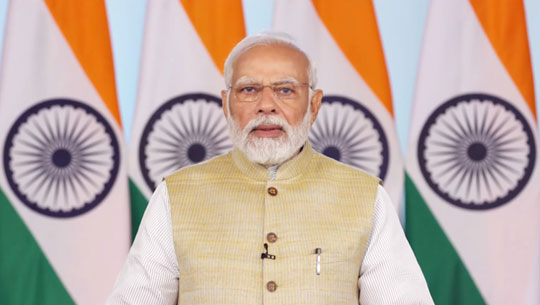
Prime Minister Narendra Modi recently addressed the core ideological foundations of the Bharatiya Janata Party (BJP), asserting that the organization has successfully established a new, transformative principle in Indian politics: the doctrine of 'Nation-First'. Speaking on the impact of policy decisions in Jammu and Kashmir, the Prime Minister emphasized that his administration remains steadfast in its commitment to prioritizing national integrity and constitutional unity over political expediency.
The Legacy of Syama Prasad Mookerjee
A focal point of the Prime Minister's remarks was the long-standing ambition regarding Article 370, which granted special status to the region of Jammu and Kashmir. Modi noted that the revocation of this constitutional provision was not merely a legislative act but the fulfillment of the foundational dream of Dr. Syama Prasad Mookerjee, the founder of the Bharatiya Jana Sangh. For decades, the party had campaigned on the platform of 'Ek Vidhan, Ek Nishan, Ek Pradhan' (One Constitution, One Flag, One Prime Minister), a vision Mookerjee championed during his struggle for the integration of Kashmir into the Indian Union.
According to the Prime Minister, the decision to abrogate the special status effectively integrated the region into the national mainstream, thereby dismantling a barrier that had persisted for generations. He credited this move as a historic turning point that ensures equal rights and opportunities for all citizens of the region, aligning with the broader vision of a unified and stronger India.
A Shift in Political Culture
Beyond specific policy successes, the Prime Minister spoke extensively on the evolution of political discourse in India. He argued that the BJP has pioneered a departure from traditional 'vote-bank' politics, replacing it with a development-oriented governance model that emphasizes national progress. This 'Nation-First' approach, he claimed, is the guiding light for every worker within the party. By focusing on long-term systemic changes rather than short-term electoral gains, the BJP aims to foster a culture where administrative decisions are measured against their contribution to the nation's collective welfare.
Recognition and Regional Integration
In his address, the Prime Minister also took a moment to acknowledge the contributions of various leaders and regional entities that have recognized the significance of historical figures in India's nation-building process. He lauded the government of West Bengal for taking steps to honor Dr. Syama Prasad Mookerjee, noting that recognizing the contributions of such leaders is essential for national cohesion. This acknowledgment serves as a broader invitation to bridge regional divides through shared respect for the architects of modern India.
Looking Toward the Future
The Prime Minister concluded by reiterating that the era of 'Nation-First' politics is here to stay. He encouraged party workers and the public to view the current developmental trajectory of the country through the lens of empowerment and inclusion. By fulfilling the promises made to the founding fathers and addressing the aspirations of the youth, the current government seeks to cement a legacy of decisive, principled, and bold governance that serves the interest of every citizen across the country.
How do you feel about this story?
Discussion
No comments yet. Be the first to share your thoughts.
Join the discussion
Sign in to share your thoughts on this story.