BNN Summary
Prime Minister Narendra Modi has lauded the Bharatiya Janata Party for fundamentally shifting India's political culture. During a recent address, he emphasized that the party has moved beyond traditional power-centric models to establish a 'Nation-First' principle, prioritizing national development and public welfare above partisan gains.
In-Depth Analysis
Prime Minister Narendra Modi recently addressed senior leaders and cadres of the Bharatiya Janata Party (BJP), marking a pivotal moment in the discourse surrounding Indian political governance. During his speech, the Prime Minister highlighted what he described as a transformative shift in the nation's political landscape, asserting that the BJP has successfully institutionalized a 'Nation-First' principle that distinguishes it from historical political paradigms.
A Shift in Political Philosophy
For decades, observers of Indian democracy have argued that electoral politics were frequently defined by regional interests, caste-based calculations, and short-term vote-bank strategies. PM Modi argued that the BJP has systematically moved away from these conventions. He noted that the party's primary objective has evolved into a 'service-first' mission, where national growth indicators, infrastructure development, and the welfare of marginalized populations take precedence over purely electoral arithmetic.
'The BJP has established a new principle in Indian politics, which is that of Nation-First,' the Prime Minister stated. He elaborated that this philosophy is not merely a slogan but a governing mandate that dictates policy decisions ranging from economic reforms to foreign policy assertions.
Pillars of the Nation-First Approach
According to the Prime Minister, this principle is supported by several core pillars that have redefined the party's administrative tenure:
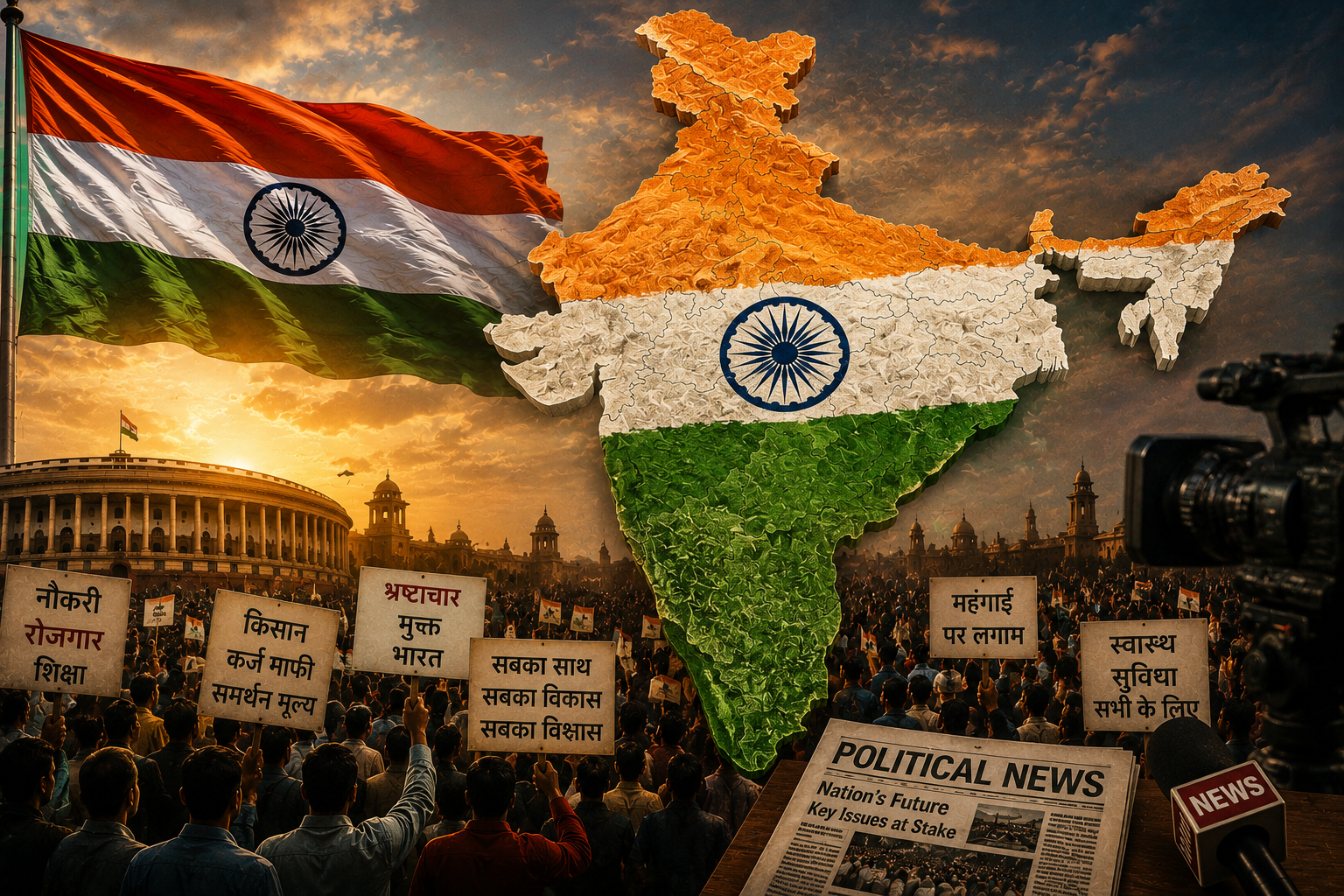
- Inclusive Development: By focusing on 'Sabka Saath, Sabka Vikas' (Together with All, Development for All), the government claims to have ensured that the fruits of growth reach the last person in the socio-economic queue without discrimination.
- Long-term Institutional Vision: Unlike administrations that focused on quick-fix populist measures, the current government has emphasized structural reforms, such as the digital transformation of the economy and the modernization of infrastructure (including railways, highways, and digital connectivity), which are designed to benefit the nation over several decades.
- Cultural Resurgence: The Prime Minister also pointed to the rejuvenation of India's cultural heritage as a vital component of this nation-first identity, suggesting that a country can only progress when it takes pride in its civilizational history.
Challenging Traditional Dynastic Politics
Much of the Prime Minister's rhetoric centered on the contrast between the BJP's organizational structure and what he termed 'dynastic' or 'family-based' politics. He argued that when political parties are managed by individual families, the primary goal of the party becomes the preservation of that family's political capital. In contrast, he posited that the BJP operates on an ideological framework where even the lowest-ranking volunteer is dedicated to the broader national cause.
Future Outlook
This assertion comes at a time when the BJP is looking to consolidate its influence across diverse regions of India. By framing the party's existence as a guardian of the 'Nation-First' principle, the leadership is attempting to move the goalposts of political debate. The focus is no longer just on 'who wins' an election, but on 'what kind of India' is being built. As the nation approaches future electoral cycles, this narrative of ideological superiority is expected to remain a central theme of the party's outreach, challenging opposition parties to justify their own political motives against the yardstick of national interest.
How do you feel about this story?
Discussion
No comments yet. Be the first to share your thoughts.
Join the discussion
Sign in to share your thoughts on this story.